Paris doesn’t sleep-it just changes menus.
Most tourists leave Paris by 8 p.m., chasing the last metro home. But the real city wakes up after that. The lights dim in the Louvre, the crowds thin on the Champs-Élysées, and suddenly, the streets smell like fresh baguettes, sizzling garlic butter, and roasted chestnuts. This isn’t the Paris of postcards. This is the Paris of locals, of chefs off the clock, of wine bars where the bartender knows your name and the cheese counter is still open.
You don’t need a reservation at a three-star Michelin place to eat well in Paris at night. You need to know where to walk.
Where to eat when the tourist spots are closed
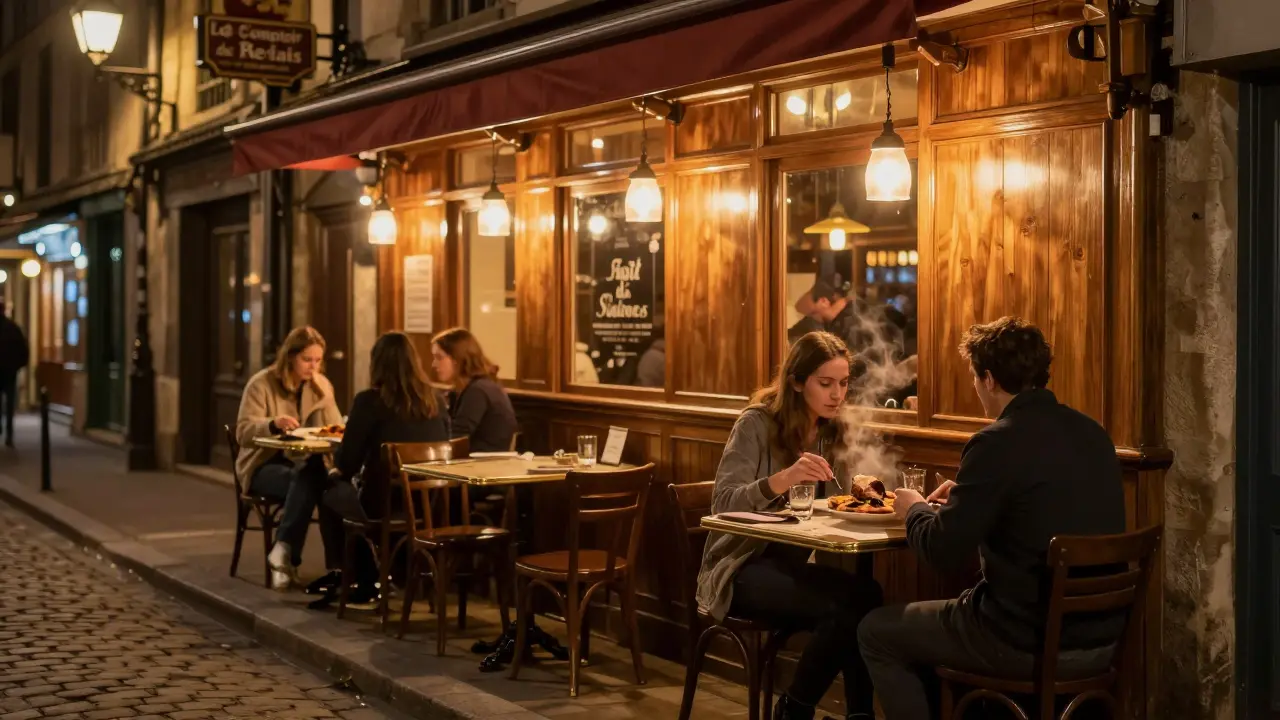
Le Comptoir du Relais in Saint-Germain is one of those places that never feels crowded, even at 11 p.m. It’s small, wood-paneled, and has only eight tables. The menu changes daily, but you’ll always find duck confit, escargot in parsley butter, and a plate of charcuterie that tastes like it was cured in 1972. The owner, Yves, doesn’t take reservations after 9 p.m.-you just show up, sit at the bar, and let him decide what you eat. It’s not fancy. It’s perfect.
Across the Seine in the 13th arrondissement, Le Bar à Vin is where Parisians go after work. No one here speaks English. No one needs to. You point at the wine list-it’s organized by region, not price-and they pour you a glass of natural Beaujolais that costs €6. Then you order the tartine: sourdough toast, goat cheese, honey, and a sprinkle of black pepper. It’s the kind of snack that makes you forget you’re standing in a narrow alley with a glass of wine in one hand and a napkin in the other.
Midnight snacks that aren’t kebabs
Everyone knows about the kebab stands on Rue de la Villette. But if you want something real, go to La Crêperie de la Place de la République at 1 a.m. The line snakes out the door, but it moves fast. The batter is made with buckwheat, the butter is salted, and the fillings are simple: ham and Gruyère, or mushrooms and cream. You eat it standing up, paper napkin in hand, steam rising off the crepe like a warm hug. It’s not gourmet. It’s necessary.
In Montmartre, La Maison Rose has a secret: their midnight croque-monsieur. Not the fancy version with truffle oil. The real one: toasted bread, melted Gruyère, a thin slice of ham, and a fried egg on top. They serve it with a side of pickled cornichons. You don’t ask for ketchup. You don’t need it.

The wine bars that feel like home
Paris has over 1,200 wine bars. Most are terrible. A few are magical.
Le Verre Volé in the 10th arrondissement opened in 2008 and still feels like a secret. The owner, Sophie, only stocks wines from small producers-no big brands, no labels you’ve seen in supermarkets. She’ll ask you what you like: fruity? earthy? bitter? Then she picks a bottle and pours you a taste. You pay €8 for a glass that costs €25 elsewhere. The cheese board is from a farm in the Ardèche. The bread is baked two doors down. You don’t leave for an hour.
Down in the 11th, Le Château d’Eau has no sign. Just a red door and a chalkboard that says "Vin Naturel". Inside, the tables are mismatched, the music is jazz from the 60s, and the staff never says "bon appétit." They say "tu as faim?"-are you hungry?-and bring you a plate of olives and dried sausage without asking. This is where people come to unwind, not to impress.
Where to find the best coffee after midnight
Paris isn’t known for coffee. But that’s changing.
Ten Belles in the 10th opens at 7 a.m. and closes at 2 a.m. They roast their own beans in the back. The espresso is bold, clean, and served in thick ceramic cups. You can get a latte with oat milk, but most people order it black. The barista will ask if you want it with a croissant. You say yes.
In the 18th, La Caféothèque is a coffee shop that doubles as a tasting room. They have 40 different single-origin beans from Ethiopia, Colombia, and Indonesia. You can order a pour-over that takes 3 minutes to brew. Or you can just ask for "la plus forte"-the strongest one. They’ll nod, grind the beans, and hand you a cup that tastes like dark chocolate and burnt sugar. It’s not sweet. It’s awake.
What to drink when you’re not drinking wine
Parisians don’t drink cocktails like New Yorkers do. But they’ve started.
Bar à Vin in the 11th has a small list of low-alcohol drinks made with vermouth, bitters, and house-made syrups. Try the "Café Noir"-espresso syrup, black walnut bitters, and a splash of soda. It’s bitter, sweet, and smells like a Parisian winter night.
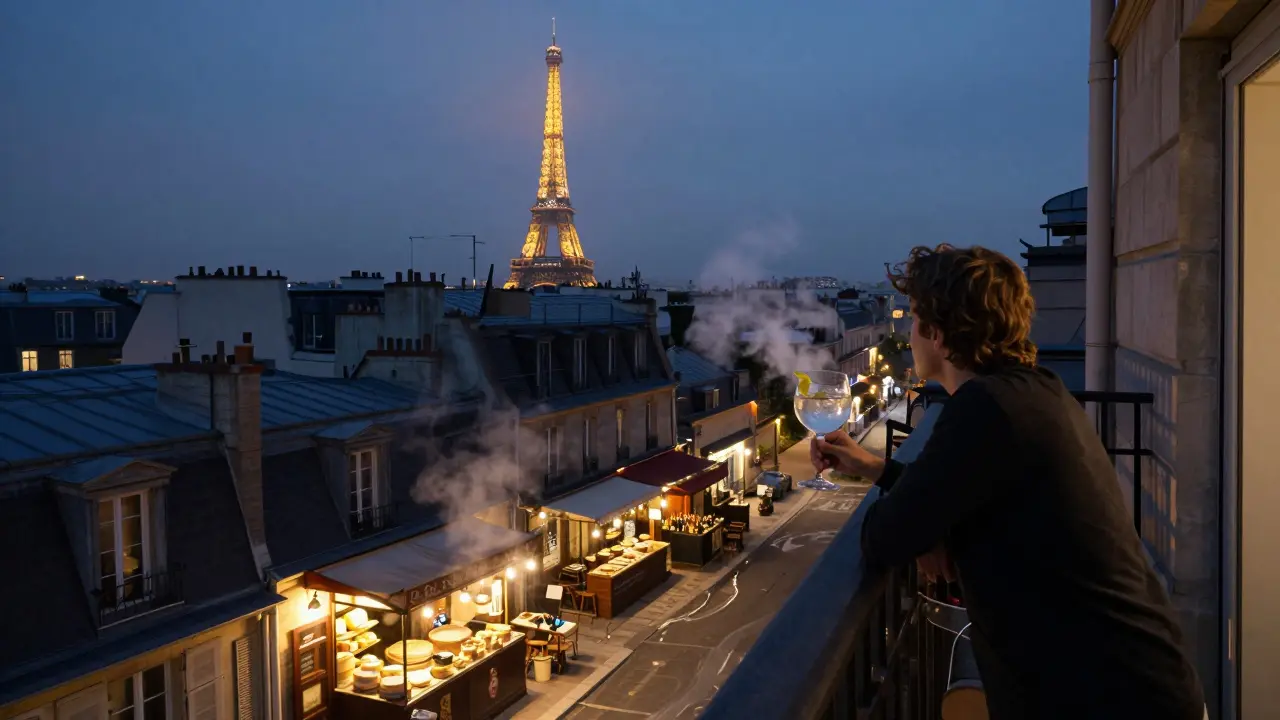
For something stronger, head to Le Perchoir on the rooftop of a building near Canal Saint-Martin. The view is stunning-the Eiffel Tower glows in the distance. But you don’t come for the view. You come for the gin. They make their own gin with juniper, coriander, and orange peel. It’s served with a single ice cube and a twist of lemon. No soda. No garnish. Just the drink, the cold air, and the silence between the city’s pulses.
How to navigate the scene like a local
Don’t follow the maps. Don’t look for "top 10 nightlife spots." Walk. Turn left when you see a line of people waiting for food. Go where the lights are still on after 1 a.m.
Parisians don’t go out to "party." They go out to eat, drink, and talk. You’ll see couples sharing a bottle of wine at 2 a.m. Groups of friends arguing about politics over cheese. Old men playing chess at sidewalk tables with a glass of pastis.
Don’t rush. Don’t check your phone. Sit down. Order something simple. Let the night move at its own pace.
When to go-and when to skip it
Weeknights are quieter. But that’s when the real gems open. Tuesday and Wednesday are the best nights to find empty tables at Le Comptoir du Relais. Thursday and Friday are packed, but worth it if you want energy.
Avoid the 1st and 8th arrondissements after 10 p.m. unless you’re looking for overpriced champagne and fake jazz. The real food is in the 10th, 11th, 13th, and 18th. That’s where the chefs live. That’s where they eat.
And if you’re there on a Sunday? Go to Marché des Enfants Rouges at 11 p.m. It’s the only market in Paris open late on weekends. The stall selling roasted chestnuts has a line. The one selling warm crêpes? Always full. The guy selling mulled wine? He’ll pour you a cup and say, "C’est la vie." And for a moment, you’ll believe him.
Is Paris safe at night for solo travelers?
Yes, most areas where people eat and drink at night are safe. Stick to neighborhoods like Le Marais, Saint-Germain, the 10th, and 11th arrondissements. Avoid isolated streets near train stations after midnight. The metro runs until about 1:30 a.m., and night buses (Noctilien) cover the city. Always keep your belongings close-pickpockets are rare but do exist.
What’s the best time to eat dinner in Paris at night?
Most Parisians eat dinner between 8 p.m. and 10 p.m. But if you want to avoid crowds and get the best service, aim for 7:30 p.m. or after 10:30 p.m. Many small restaurants don’t serve food after 11 p.m., but the ones that do-like Le Comptoir du Relais or Le Bar à Vin-are worth the wait.
Do I need to make reservations for late-night spots?
For most places, no. Le Comptoir du Relais doesn’t take reservations after 9 p.m. Le Verre Volé and Le Château d’Eau are first-come, first-served. If you’re going to a popular spot like Le Perchoir, a reservation helps-but even then, you can often get in if you wait at the bar. Walk-ins are the norm.
Are there vegetarian options in Paris at night?
Yes. Many wine bars offer cheese and charcuterie boards that can be made vegetarian. Crêperies serve mushroom and goat cheese crêpes. At La Caféothèque, you can get a lentil salad or roasted vegetable tartine. Just ask: "Vous avez des options végétariennes?" Most places will have something.
How much should I expect to spend on a night out eating in Paris?
You can eat well for €20-€30. A glass of wine (€6-€8), a tartine or crêpe (€8-€12), and a coffee (€3-€4) will cover a full night. At a place like Le Perchoir, a gin and tonic is €14. But if you skip the fancy cocktails and stick to local wine and snacks, you’ll spend less than you would on a single meal in most other European capitals.
What to do after the last train
When the metro stops, the city doesn’t end. It just slows down.
Walk. Listen. Smell the bread from the bakery still open. Watch the old man sweeping the sidewalk outside his boulangerie. See the light still on in the window of the cheese shop where the woman is cutting you a slice of aged Comté.
Paris by night isn’t about clubs or neon signs. It’s about quiet corners, warm food, and the kind of moments you can’t plan.